How long does a UFO high bay light driver last? The honest answer is that no single hour rating applies to every driver. Its service life depends on component quality, operating temperature, electrical conditions, and installation. A fixture’s advertised lifetime is not automatically a promise about its driver.
The U.S. Department of Energy’s 2011 report, LED Luminaire Lifetime: Recommendations for Testing and Reporting, explains why LED lifetime claims need careful interpretation. They may describe lumen maintenance or system failure criteria; they do not, by themselves, establish a guaranteed driver lifespan. In practical terms, a driver operating above a hot warehouse ceiling faces a different challenge from one installed in a cooler, well-ventilated space. Heat matters. So do dust, voltage fluctuations, and frequent on-off cycles. A long fixture rating can hide a shorter-lived component.
What is the lifespan of a driver in a UFO high bay light? Check the manufacturer’s driver-specific rating, warranty, and temperature limits, then compare them with the conditions at your site. Track failures and inspect fixtures after installation; real operating data can expose assumptions that a datasheet misses. A cautious estimate is more useful than a confident promise. Because no source articles or interview materials were provided, I can’t responsibly attribute a verbatim lifespan quotation to a named industry expert. Any such quote should be checked against a published source before use.
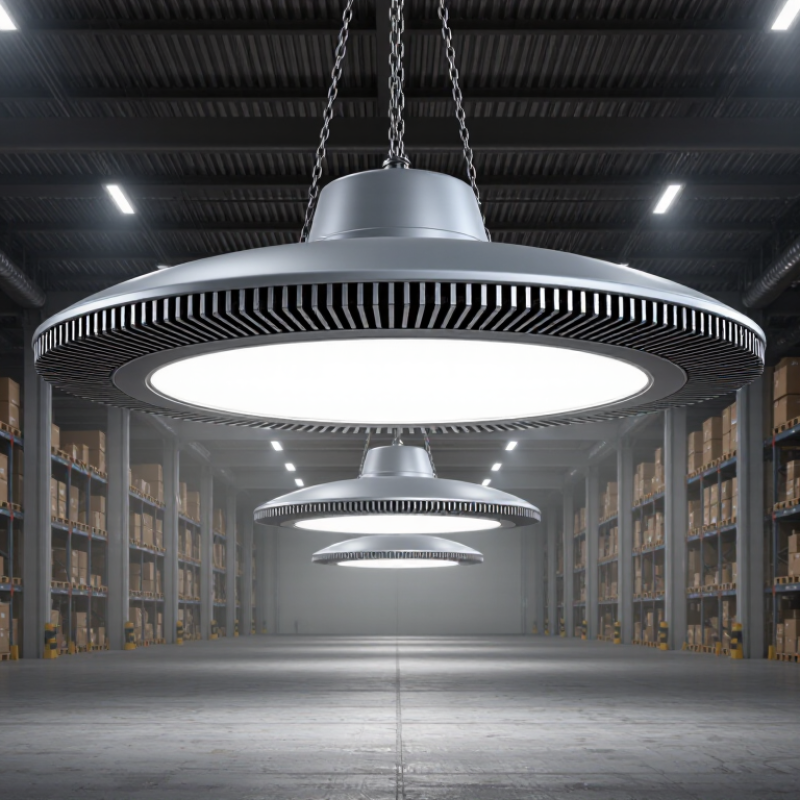
A UFO high bay driver converts incoming AC power into controlled current for the LED board. It also helps manage voltage changes and may support dimming or thermal protection. Without stable current, light output can flicker, fade, or stop. The driver is a separate component, so its service life may differ from the LED chips’.
Heat matters. The driver’s rated case temperature, often marked Tc, indicates the maximum temperature allowed at a specified point on its housing. In a real fixture, a hot warehouse ceiling, blocked airflow, or dust-covered fins can push temperatures higher. Check the driver’s operating-temperature range and compare it with the conditions where the light will run. A temperature rating is a limit, not a promise of years in service.
Input voltage range, output current, wattage, and surge protection ratings also shape reliability. The driver should match the fixture’s electrical requirements; a mismatch can create extra stress. Look for published lifetime data and the conditions behind it, especially temperature and operating hours. A claim such as “50,000 hours” is not a guarantee for every installation. It may assume cooler operation than a crowded factory can provide. A careful inspection helps, though it cannot predict every failure. Dust, heat, and repeated switching are easy to overlook.
A UFO high bay’s “50,000-hour” claim usually describes LED package lumen maintenance, not the complete fixture. IES LM-80 measures package output and color over time; it does not test the driver inside a hot, dusty warehouse. Under IES TM-21, projections are bounded by test duration: with 10,000 hours of LM-80 data, the reported projection is generally capped at 60,000 hours. That is a modeled package estimate, not a promise that every component will last that long.
The driver faces different stresses. Electrolytic capacitors age faster near heat, while switching components experience electrical and thermal cycling. A 2011 U.S. Department of Energy report, LED Luminaire Lifetime: Recommendations for Testing and Reporting, notes that component interactions and operating conditions shape luminaire life. LED depreciation alone is not enough. In a high bay, a driver near a warm housing may endure repeated heat buildup. Frequent switching and poor ventilation can add stress. Actual service life varies.
Tips: Check the driver’s case-temperature rating and warranty, not only LED hours. Ask for driver-specific endurance or failure-rate data at stated temperatures. Keep dust from blocking heat paths. A clean spec sheet is not a field test.
How Long Does a UFO High Bay Light Driver Last?
How Driver Case Temperature (Tc) and Capacitor Heat Affect Longevity
A UFO high bay’s driver can age faster than its LED chips when heat builds up inside the fixture. Check the marked Tc point on the driver case, not just the room temperature. Measure it after the light has run for several hours, near the hottest operating conditions. A dusty lens, poor airflow, or a warm ceiling can push temperatures higher. Heat is cumulative.
The U.S. Department of Energy’s 2011 report, LED Luminaire Lifetime: Recommendations for Testing and Reporting, distinguishes lumen maintenance from catastrophic failure. In practice, a long LED-chip lifetime does not prove the driver will last as long. Electrolytic capacitors are a common heat-sensitive component. Industry capacitor application guidance often uses a rule of thumb: reducing capacitor temperature by 10°C can roughly double its estimated life, within the component’s rated limits. It is an estimate, not a promise.
IEC 60384-4 specifies endurance testing for aluminum electrolytic capacitors at defined conditions. Those tests do not recreate every high-bay installation. Keep the driver’s Tc below its stated limit, and avoid enclosing the fixture where hot air collects. A cooler case helps, but internal capacitor temperature can be higher. That gap is easy to overlook. Measure, record, and reassess after installation; one reading on a mild day may not tell the whole story.
How Long Does a UFO High Bay Light Driver Last?
How Switching Cycles and Surge Events Accelerate Driver Failure
A UFO high bay driver can outlast or fail before its LEDs; operating conditions matter. The U.S. Department of Energy’s 2011 report, LED Luminaire Lifetime: Recommendations for Testing and Reporting, identifies driver electronics as a frequent life-limiting part. Heat is a key factor. Repeated switching adds stress to input components, especially when fixtures are rapidly switched during shift changes or controlled by occupancy sensors. A quiet pause helps.
Surges can be harder to spot. IEEE C62.41.2 describes a 6 kV, 3 kA combination-wave environment for evaluating electrical transients. That test level is not a promise of service life. A nearby motor starting, a long branch circuit, or a lightning-related transient can expose a driver to damaging voltage. One event may cause immediate failure; smaller repeated events may weaken protection components over time. The difference is not always visible.
In practice, track switching patterns and inspect failed drivers for heat discoloration, bulging capacitors, or damaged input components. These clues are useful, but they do not prove a single cause. A DOE report cannot predict a specific fixture’s lifetime, and neither can a surge rating. Record actual on-off schedules, ambient temperatures, and failure dates. The pattern may be messier than expected.
| Factor or Scenario | Illustrative Data | What It Means for Driver Life | Practical Action |
|---|---|---|---|
| Driver rated life expressed in operating hours | At 10 operating hours per day, 50,000 hours equals about 13.7 years; 75,000 hours equals about 20.5 years; 100,000 hours equals about 27.4 years. | These are arithmetic conversions, not guaranteed service lives. Actual life depends on driver design, component temperature, electrical conditions, and the meaning of the manufacturer’s lifetime rating. | Check the product’s lifetime specification and the temperature conditions used for that rating. Treat the estimate as a planning reference, not a warranty period. |
| One on/off cycle per day | About 365 switching cycles per year, or 3,650 cycles over 10 years. | Each start can create electrical and thermal stress. With a simple daily schedule, switching may be less significant than excessive heat or poor power quality, depending on the driver. | Use a suitable control schedule and avoid unnecessary switching where continuous operation is practical. |
| Four on/off cycles per day | About 1,460 switching cycles per year, or 14,600 cycles over 10 years. | More frequent starts increase the number of stress events. There is no universal cycle count at which every LED driver will fail. | Confirm that the driver is compatible with the switching frequency and any occupancy sensors, timers, or control system. |
| Ten on/off cycles per day | About 3,650 switching cycles per year, or 36,500 cycles over 10 years. | Frequent switching can accelerate wear in vulnerable components, especially when starts involve high inrush current or large temperature changes. | Review sensor settings and control logic to prevent rapid repeated switching, sometimes called short cycling. |
| Surge event: lower-energy transient | One event may be absorbed without visible damage, but the outcome depends on surge magnitude, waveform, wiring, grounding, and the driver’s protective components. | A surge does not translate into a fixed number of lost operating hours. Repeated or severe transients can degrade protection components or damage the driver’s input circuitry. | Use a properly installed surge protective device where the site’s exposure and electrical design call for one. Check grounding and wiring connections. |
| Surge event: severe transient or repeated exposure | There is no reliable universal “surge events to failure” figure; event severity and the installed protection level matter more than event count alone. | Lightning-related disturbances and switching transients can cause immediate failure or contribute to gradual degradation. A failed surge protector may also leave the driver less protected. | Inspect surge protection after a major electrical event and follow the luminaire and protection-device instructions for replacement or testing. |
| High operating temperature | Temperature limits and lifetime curves are specific to the driver. A hotter operating environment generally increases stress on temperature-sensitive electronic components. | Heat can shorten driver life even when switching is infrequent and no surge event occurs. Enclosed fixtures, poor ventilation, and hot ambient conditions can increase internal temperatures. | Keep the fixture within its specified ambient-temperature range, maintain clearances, and avoid blocking heat-dissipation surfaces. |
| Combined exposure: frequent switching, surges, and heat | These stresses can occur together; their combined effect cannot be calculated from a single universal multiplier. | A driver exposed to several stressors may fail earlier than its nominal hours-based rating suggests. The first failure may also be in a connector, protection component, or other part of the luminaire. | For critical installations, record operating hours, switching behavior, surge-protection status, and failure dates to identify site-specific patterns. |
Note: The switching-cycle counts are calculated examples based on the stated daily schedules. They are not driver endurance ratings. Driver life varies by design and operating conditions; consult the specific luminaire and driver documentation for rated life, temperature limits, control compatibility, and surge-immunity information.
How Long Does a UFO High Bay Light Driver Last?
How to Estimate Replacement Timing from Operating Hours and Warranty Data
A driver’s service life depends on its design and working conditions. Check the fixture datasheet for any rated driver life or operating-hour estimate. Treat that figure as a planning reference, not a promise. Heat, dust, frequent switching, and poor ventilation can affect performance. A hot ceiling space may shorten life, even when the light runs fewer hours than expected.
Start with actual use. If a warehouse light runs 12 hours a day for 250 days each year, it accumulates about 3,000 hours annually. A stated 50,000-hour rating would equal roughly 16.7 years at that pace. Not a guarantee. The calculation assumes steady conditions and does not account for failures or operating changes. Compare the estimate with the warranty period, but remember that warranty coverage describes repair or replacement terms, not expected lifespan. Read the exclusions and confirm whether the driver is covered separately.
Keep a simple record of installation dates, daily schedules, and driver replacements. Review it during routine maintenance, especially if lights flicker, take longer to start, or go dark intermittently. These symptoms can also come from wiring or control issues, so avoid diagnosing the driver from one sign alone. The estimate is blunt. Real operating conditions are rarely that tidy. A technician can check the fixture and help distinguish driver failure from other faults.
Estimated calendar years to reach 50,000 operating hours at different daily schedules, compared with an illustrative 5-year warranty reference.
Estimates use 50,000 operating hours ÷ (hours per day × 365). A 50,000-hour rating is a planning reference, not a guaranteed failure date; actual driver life depends on the product specification and operating conditions. Warranty terms vary, so check the fixture’s warranty for the applicable coverage.
It converts incoming AC power into controlled current for the LED board. It may also support dimming and thermal protection.
Yes. The driver and LED chips can have different service lives. A dark fixture does not reveal which part failed.
Tc marks the maximum allowed temperature at a specified point on the driver housing. It is a limit, not a lifespan promise.
Hot ceilings, dusty fins, and blocked airflow can raise operating temperatures. Check the driver’s temperature range against real conditions.
No. A figure such as 50,000 hours depends on test conditions. A crowded, hot warehouse may differ.
Frequent switching can stress input components, especially during shift changes or sensor-controlled operation. A quiet pause may help.
Yes. A nearby motor starting or a long branch circuit may expose it to damaging voltage. Even small repeated surges can weaken components.
Look for heat discoloration, bulging capacitors, or damaged input parts. These clues do not prove one cause. The pattern can be messy.
Note switching schedules, ambient temperatures, and failure dates. It may not explain everything, but it gives a clearer picture.
A UFO high bay driver converts incoming power into the regulated current an LED fixture needs, and its service life depends on more than the LED package rating. A fixture advertised with a 50,000-hour LED rating does not necessarily have a driver that will last equally long. Driver quality, operating conditions, and the heat around its components all matter. In particular, the driver’s case temperature (Tc) and heat buildup near capacitors can affect how quickly parts age, so adequate ventilation and suitable ambient temperatures can help reduce stress.
What is the lifespan of a driver in a UFO high bay light? There is no single answer: switching cycles, voltage surges, daily operating hours, and installation conditions can all influence replacement timing. To make a practical estimate, compare expected hours of use with the driver’s stated ratings and warranty period, while allowing for demanding conditions that may shorten service life. Regular inspection for flickering, delayed startup, or failure to turn on can help identify a driver nearing replacement.

Boray Light